


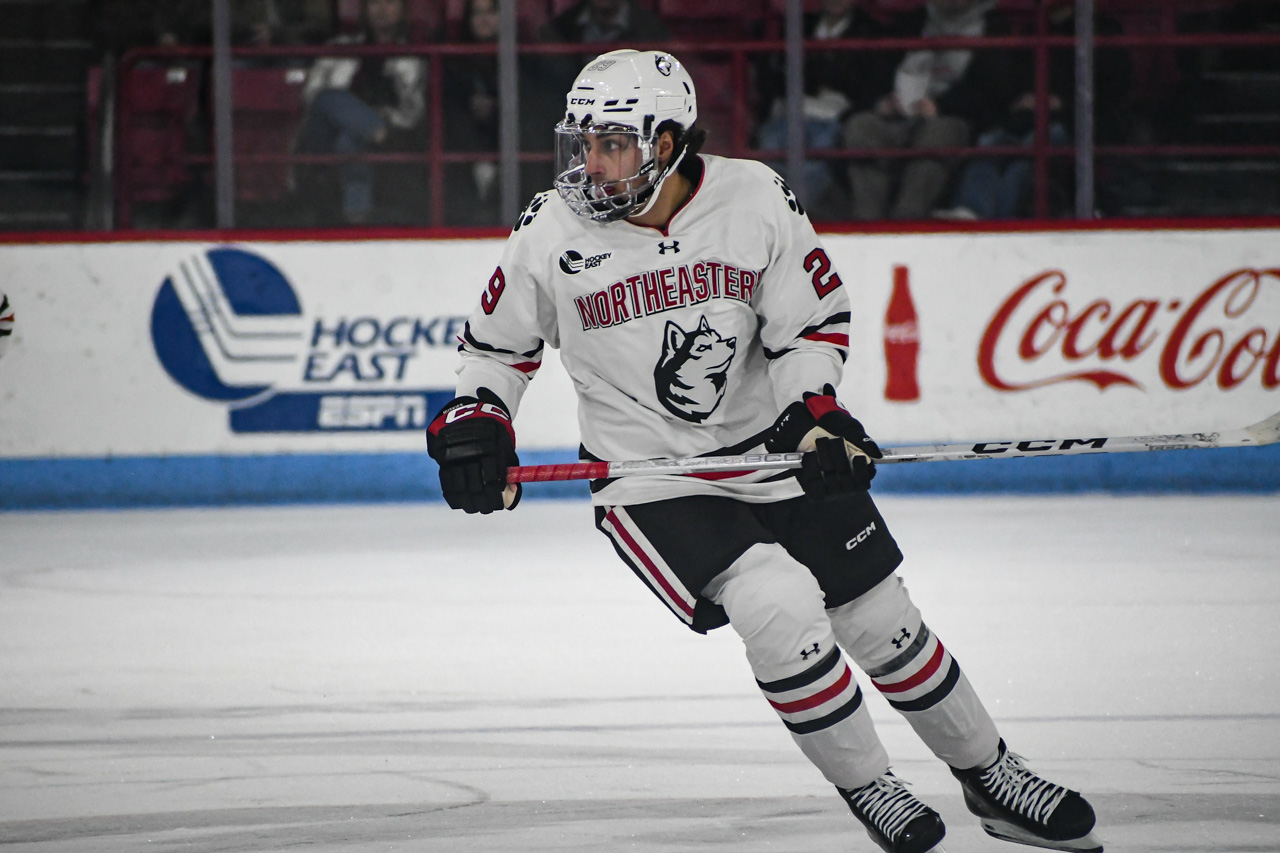
BOSTON — It was the early morning hours of Monday, March 18, less than 48 hours after Northeastern’s season came to an end against Boston University in the Hockey East quarterfinals, and associate head coach Mike Levine was wired.
For Levine and Northeastern’s entire coaching staff, the days immediately following the season are among the most critical and high-pressure of his year. Levine was already knee-deep in tape of players around the country, making quick evaluations of their skills, traits, and potential fit in Northeastern’s system. When not watching film, he was dialing coaches, advisors, agents, and family members, as he aimed to efficiently collect background information on potential recruits and gauge mutual interest.
Levine plays a central role in Northeastern’s efforts in transfer portal, which has become a rough equivalent of free agency in men’s college hockey. The Huskies have embraced the sport’s new and chaotic method of roster building, adding five transfers last offseason and six this year — the second-most of any program in Hockey East.
“Things happen pretty quickly once players go into the portal. So you have to be ready,” said Levine. “You have to almost start the recruiting process immediately once there is interest.”
The landscape of college athletics has evolved rapidly over the past three years, following a series of NCAA rule changes and court decisions which eased restrictions on player movement and enabled athletes to profit off their Name, Image, and Likeness (NIL). In college hockey, the volume of transfers has grown each of the past five years, reaching an all-time high of 312 in the 2024 offseason.
Northeastern was among college hockey’s successful early adoptees of the portal, beginning with Tommy Miller (Michigan State) and Jakov Novak (Bentley) in 2021. Last year, Alex Campbell, a transfer from Clarkson, tallied 22 goals and 42 points in his lone season at Northeastern, the second-highest point total of any transfer in the county.
In the 2024 offseason, the Huskies emerged from the chaos with another prized transfer class. The group is headlined by Omaha junior defenseman Jo Lemay, Quinnipiac senior wing Christophe Tellier, and Colgate senior center Ryan McGuire, each ranked among the nation’s top transfers at their respective positions. Northeastern also bolstered their blue line depth with seniors Jake Boltmann (Notre Dame) and Jake Higgins (Holy Cross), who bring 240 combined games of college experience.
“In college hockey today, you have to use the portal. There’s no way around it,” said Northeastern head coach Jerry Keefe. “I think every year is a little bit different depending on how your team is built, but it’s something we want to take advantage of.”
While a select handful of star players receive NIL compensation in college hockey, those interviewed for this story stressed that it’s not a driving factor for most transfers, since the available funds are minuscule compared to football or men’s basketball. Instead, the primary focus for most players is on finding the best program to develop their skills and earn a professional contract.
Though the end goal is straightforward, the matching process is murky, fast, and often lacks transparency.
According to Levine, Northeastern rarely locates a target by scanning the transfer portal and landing on a name fortuitously. Instead, when a player first enters the portal, their agent or advisor often initiates the process by reaching out to Northeastern’s staff and beginning a dialogue. Other times, the prospective transfer or his advisor has a pre-existing relationship with a Northeastern player or coach, which spurs the initial conversation.
“Once a player goes into the portal, you’re having conversations with their advisors. That’s something that has changed since I started,” Levine said. “Players lean more on the advisors’ opinion than ever before. So having a relationship with an advisor can help or hinder where that player ends up.”
After the initial connection is established and the coaching staff has the opportunity to pitch the player and their family directly, Northeastern is confident in what the program can offer: A long track record of developing NHL players, the high-profile stage of Hockey East and the Beanpot, a competitive roster, quality academics, and an attractive campus in the heart of Boston.
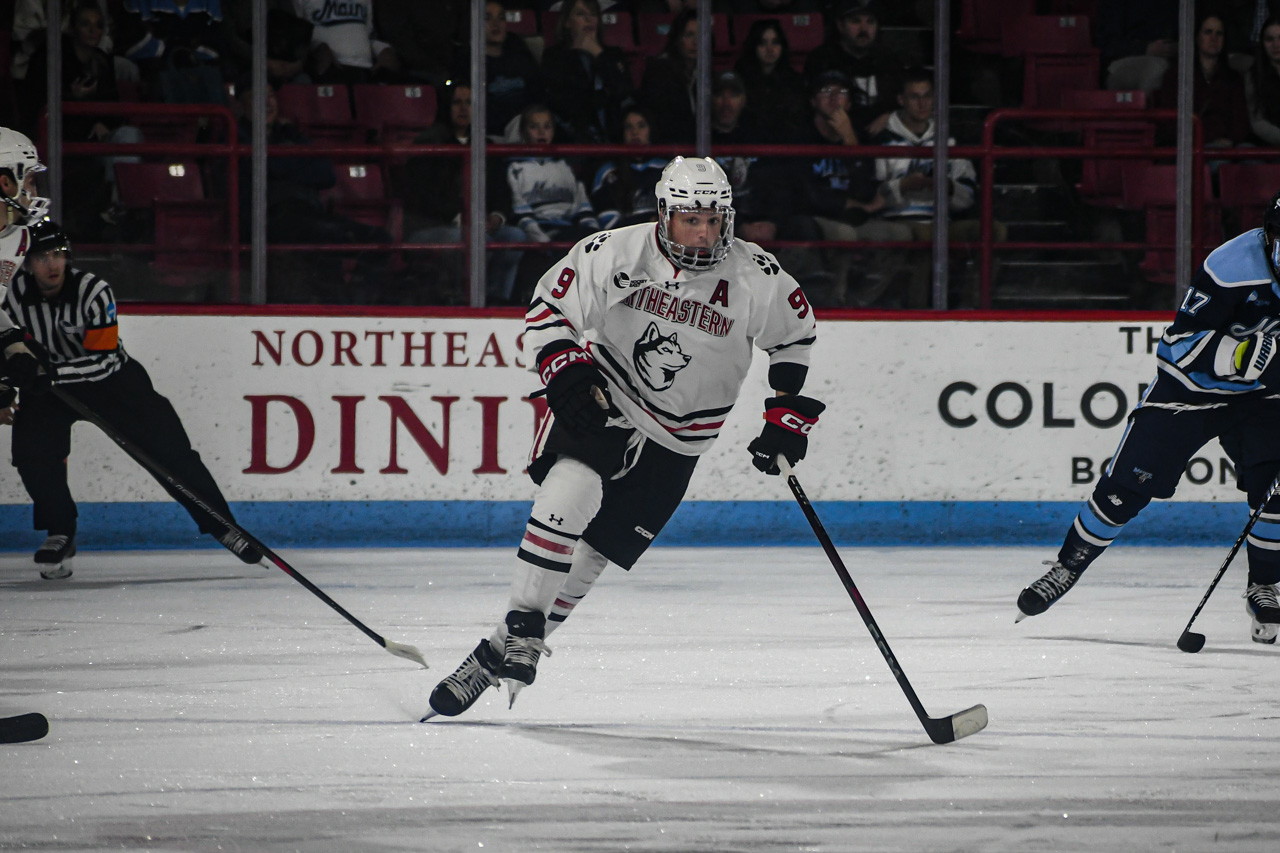
Especially with highly-sought players, the process unfolds quickly. Lemay, a fourth-round draft pick of the Washington Capitals in 2022, officially entered the transfer portal on April 4, just one week after wrapping up his breakout sophomore season at the University of Omaha. Three days later, the defender committed to Northeastern.
Immediately after his season ended at Omaha, Lemay sat down with the three parties which have the most input on his long-term development — his family, his agent, and the Capitals front office — and compiled a list of priorities. Later that same day, Lemay and his camp identified Northeastern as a program that checked all the boxes: A track record of developing professional-caliber defensemen, a featured role on a competitive team, and a school closer to his family in Quebec.
Lemay’s camp quickly got in touch with Northeastern’s coaching staff, and both sides raced to conduct their due diligence.
“It all happened so fast, so I had to trust the people who have my best interests,” Lemay said. “For us, it was about digging deep into the coaching staff and how good the team is going to be. And then even deeper than that, the structure around it, like the assistants and the strength coach … It really comes down to asking, ‘are these all hardworking people that want to develop me as badly as my own people want to?’”
Likewise, Christophe Tellier, a key piece of Quinnipiac’s 2023 national title team and one of the country’s top playmakers, entered the portal in search of improving his professional stock in his final season of college eligibility.
Tellier was introduced to Northeastern through Huskies’ captain Jack Williams, who he became friends with while playing together on the Muskegon Lumberjacks (USHL) during the 2020-21 season.
“[Williams] shot me a call right after I entered the portal, and was like, ‘we’d love to have you here,’ and talked about how exciting the team would be,” Tellier said. “So that got me interested at first.”
After Williams’ initial outreach, it was up to Keefe and Levine to sell Tellier on the development opportunities at Northeastern and his fit on the roster — an easier pitch following Campbell’s departure, which opened up a spot at left wing.
“When I started talking with coaches and stuff, I thought they had great experience, great leadership,” Tellier said. “My goal is obviously to get an NHL contract at the end of the season. And personally, I think after this year getting a bigger role on this team, I think I can make the jump to the pro level.”
Like Tellier, Ryan McGuire had many interested suitors following a breakout 14-goal junior season at Colgate. But the Belmont Hill (Mass.) product had a strong desire to play in the Beanpot, which narrowed his options and immediately put Northeastern in the conversation.
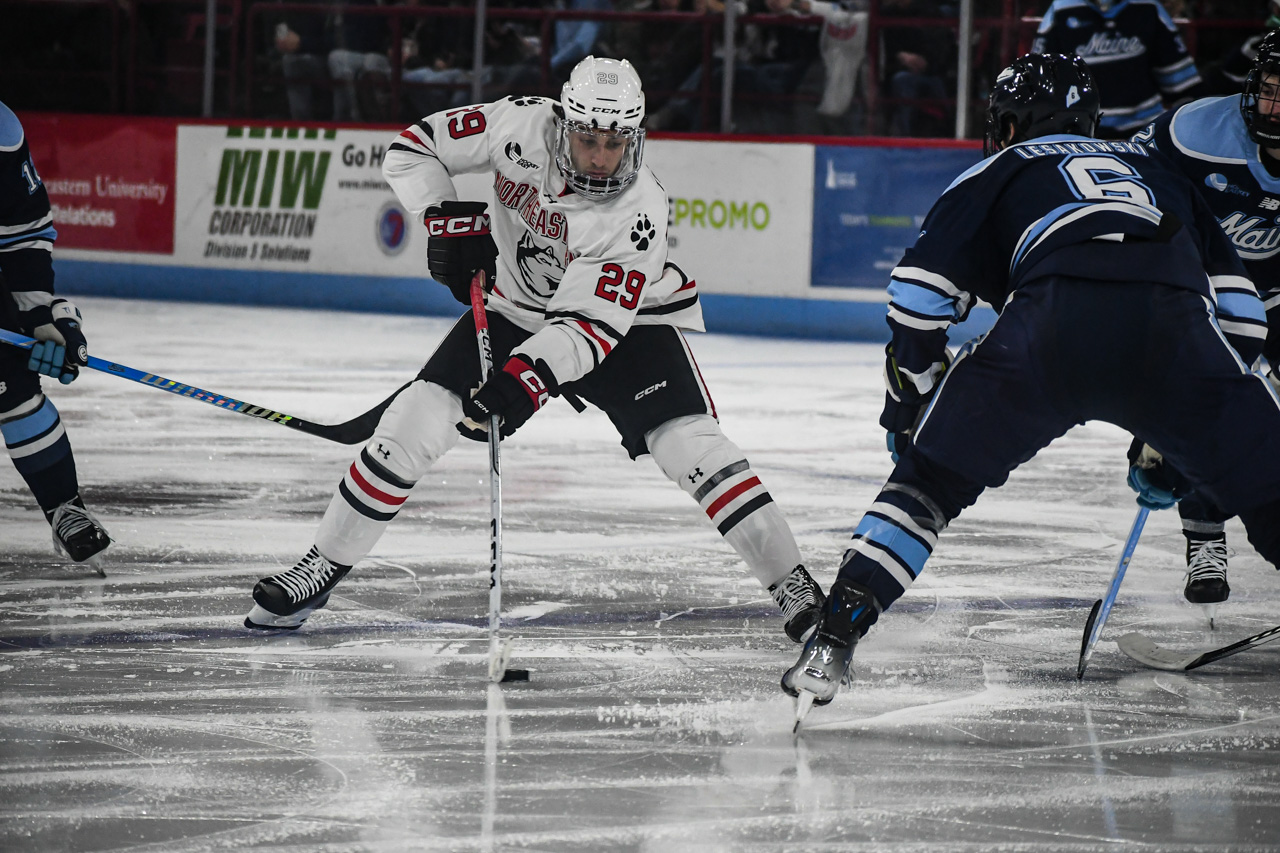
McGuire, a two-way center and one of the nation’s top faceoff takers, was a natural fit to take over the center role held by last year’s team captain Justin Hryckowian, who departed for the Dallas Stars.
“Once the season was done, I spoke a little bit to my agent about the decision to maybe move on past Colgate, and I told him I wanted to focus on a Beanpot school,” McGuire said. “So when I entered the portal, Northeastern called me pretty quick and we got in touch.”
Beyond filling a clear roster need, the additional connections also added up for McGuire. Keefe had a ringing endorsement from McGuire’s father, longtime NHL broadcaster and executive Pierre McGuire. He also skated over the previous summer with Owen Keefe, Jerry’s son and a Northeastern commit.
“My dad told me that coach Keefe, you really can trust him. He said he’s one of the best coaches he knows in college hockey,” McGuire said. “And so knowing that, and then seeing the development they’ve had with guys like Devon Levi and others, I just knew this was a place who cares about developing their players and also wins.”
Lemay echoed the importance of the Beanpot, which puts a national spotlight on Northeastern’s program each year and particularly resonates with players who grew up locally. It doesn’t hurt that Northeastern has won the title five of the past six seasons.
“I remember I was in my house last year in Omaha, watching the Beanpot, like ‘damn, this is sick.’ So I think that helped a lot,” Lemay said.
As Keefe views it, the successful outcomes of previous transfers is a key component of the Huskies’ sales pitch. Keefe highlighted defenseman Tommy Miller, who earned a contract with AHL’s Toronto Marlies after his successful 2021-22 season at Northeastern, as a roadmap for other veteran defenseman in the portal.
“I think your track record speaks for itself,” Keefe said. “You want the players to see that they transferred into Northeastern and they’ve had a great experience, and now they can do the same.”
The end goal for Keefe and his program is to build sustainable success, an objective which still begins with recruiting freshmen and developing homegrown talent over the course of three or four seasons.
But with Northeastern’s proven ability to emerge from the transfer portal process each offseason with multiple key pieces, Keefe feels using both avenues simultaneously is sustainable and neccessary.
“We want to make sure we are bringing in the right blend of younger guys that were talented as freshmen, but also some older guys that can replace what we lose,” Keefe said. “But to go out and identify really good players that have played in great programs and were big parts of their team’s success, that helps.”