


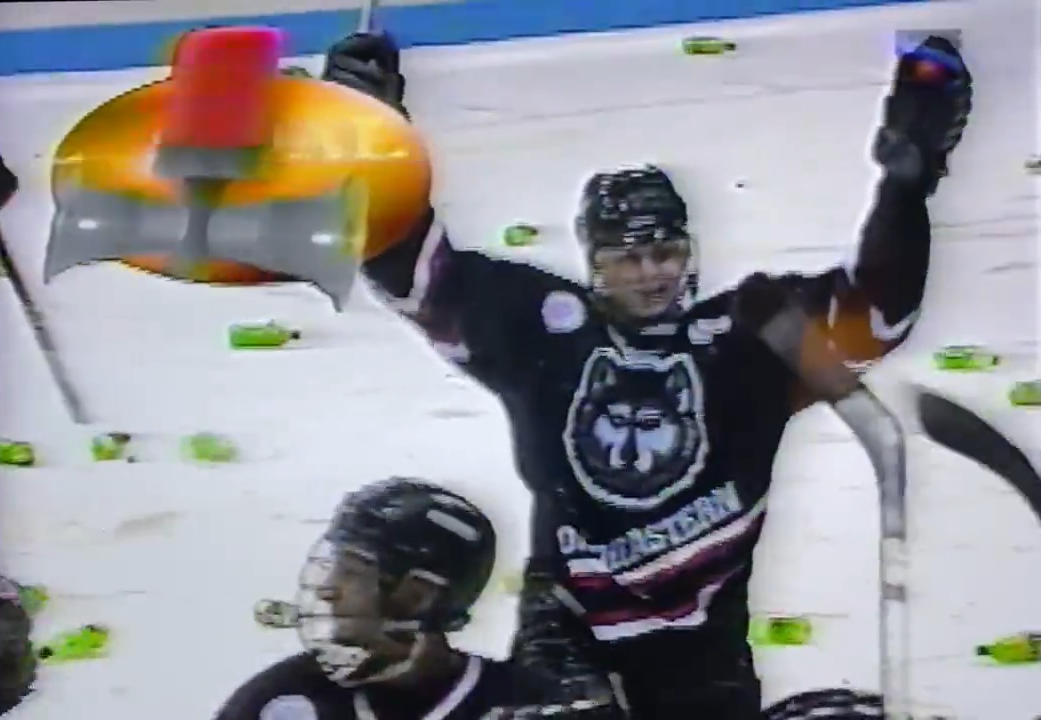
January 16, 1998.
“Titanic” was entering its fifth week at the top of the box office. “Truly Madly Deeply” by Savage Garden sat at number one on the Billboard Hot 100. The President of the United States was about to be enveloped in a sex scandal that would end up leading to his impeachment. And the Northeastern men’s hockey team was on a 12-game losing streak to BU.
That streak dated back to 1994, including an embarrassing 11-4 loss in the Beanpot title game in 1996. The last time the teams had met, at the end of the 1996-97 season, it was a 7-1 loss to the Terriers to sweep Northeastern out of the Hockey East quarterfinals and mercifully end an 8-25-3, last-place season. In the entire decade up to that point, the Terriers, led by legendary head coach Jack Parker, held a staggering 31-4 advantage in the head-to-head series against the Huskies.
“BU didn’t play football [by that point],” said Matt Straub, a sophomore student at Northeastern at the time. “We still did, but BU had already stopped. And they would be killing us in the hockey game, and we would start chanting, ‘At least we play football,’ or words to that effect. And then they would start chanting, ‘We play hockey.’ That one hurt.”
“We had a lot of close calls,” said Ben Weiss, then an equipment manager with the team, who was in his senior year that season. “I’m sure if you look back at that streak, not all of those games are blowouts. There were probably a lot of close ones that were there, and you’re just like, when are we going to get the break?
“A lot of times in that time of the mid-to-late ‘90s, you’d be lucky if you escaped with a point from a tie. Because [BU was] just that much better skill-wise.”
But coming into this game against their rival on a Friday night in January at Matthews Arena, the Huskies were on a bit of a hot streak. Led by head coach Bruce Crowder in his second season at the helm, Northeastern had won eight of their last ten games.
Crowder had arrived in Boston after spending five years as the head coach of UMass Lowell, and while he presided over that awful last-place campaign the previous season, things were starting to look up, especially as he was able to start remaking the roster to his liking.
“Coach Crowder brought some cachet because he played in the NHL,” Weiss said. “He was someone who had a strong reputation of being a good recruiter, and he had some really great assistant coaches with him. So we started to get more talented players.”
There were holdovers from the previous coaching regime, though, like sophomore forward Bobby Davis, even though Davis didn’t start playing for the Huskies until Crowder’s second year. Davis was recruited to transfer to Northeastern by the previous coach, Ben Smith, and signed two weeks before Smith left the Huskies to helm the U.S. Women’s National Ice Hockey Team.
Davis was from the Detroit area, and started his collegiate career at Northern Michigan University. He was also a musician growing up, and was in a band called Unfair Superpowers with two other friends, including a fellow hockey player named Trevor Rosen.
“I went to Northern Michigan because they would take him too, and I didn’t want the band to split up,” Davis said.
Davis’ time at NMU didn’t last long, though. He went back to juniors in the middle of his freshman season and was looking for a new collegiate home, which he would find in Northeastern.
“My recruiting trip to Northeastern, I was just blown away with the campus and the area,” Davis said. “When the new coach signed, I didn’t care. I was like, ‘I’m going to Northeastern. This place seems unbelievable.’”
Unfair Superpowers even made an appearance at Northeastern, with Davis and his bandmates playing a gig on Krentzman Quad.
“I remember they paid us 800 bucks, which seemed like a lot at the time,” Davis said. “Bruce Crowder actually loved it. He thought it was great. … And I thought that, wow, what a difference. This place is great. The other coach thought I was a jerk for playing music and having some other passions, and Bruce loved it, so I always really liked Bruce.”
(Rosen, for his part, ended up pursuing music full-time, moving to Nashville a few years later to songwrite. He would later go on to found the popular country band Old Dominion with four other bandmates he met in Nashville, and they are currently entering the third leg of a world tour.)
Davis had to sit out the 1996-97 season due to NCAA transfer rules, so the 1997-98 season was his first time actually playing for the Huskies. Davis would finish that season with 12 goals, tied with Roger Holeczy for third on the team. Todd Barclay (20-10-30) and Billy Newson (16-20-36) were the two ahead of them. The Huskies were backstopped by goalie Marc Robitaille, who finished the season with a goals against average of 3.19 and a save percentage of .904.
“It was really kind of a blue-collar group,” said Mike Trocchi, who was a sophomore student that year and the then-sports editor of the student newspaper, The Northeastern News (now known as The Huntington News). “Wasn’t a lot of goal scoring, there were a lot of close games. … [Robitaille] was a few years older than the rest of the players, so he was really a team leader. Back then we would ride on the team bus to road games, and he was really vocal before and after games on the bus. … He was definitely a huge part of that team. Kept them in a lot of games.”
What the Huskies lacked in star power and size that season, they made up for in grit.
“They were small, but quick, talented,” Straub said. “Billy Newson was a friend of mine. Little guy, fast. Barclay, gritty, could score. Roger Holeczy had a good year.
“We didn’t go into games and overpower people. … Just small, quick, but gritty. They wouldn’t let being smaller than the other team doom them. They would battle you even though you were bigger than they were.”
Northeastern came into this game against the Terriers in a four-way tie with BU, BC, and Maine for first place in the conference standings, but the Huskies had the perception that they still weren’t being taken seriously. Northeastern captain Justin Kearns was quoted in The Northeastern News that week saying that BU “think[s] of us as a team that they can beat up on.”
Despite their position in the standings, some argued that the Huskies hadn’t played against the top teams in the conference yet, and there were questions of how they would fare against the Terriers, who were ranked number three in the country at the time.
All of this, combined with the dominance of BU both locally and nationally — including appearances in three of the last four national championship games — made the Huskies feel overlooked.
“It seemed like a lot of the Mass guys knew a lot of the players from that team,” Davis said. “For me, coming from Detroit, I didn’t really understand the rivalry, or I didn’t really grow up playing against a lot of the guys. But you heard the conversations in the locker room and you kind of knew that there was not just the rivalry between the schools, but there were some personal things too.
“A lot of the guys, because BU was such a powerhouse, wanted to go there. I guess [Northeastern] was a backup option if they were going to play Division I. So, especially the guys from Massachusetts, or from the area, might have had a chip on their shoulder, wanted to beat them, or felt like they were an underdog.”
Attendance was not great at home for Northeastern around that time, especially following the previous year’s lackluster season.
“Matthews Arena was kind of a morgue at that point,” Trocchi said. “There were probably 1,500 people a game.”
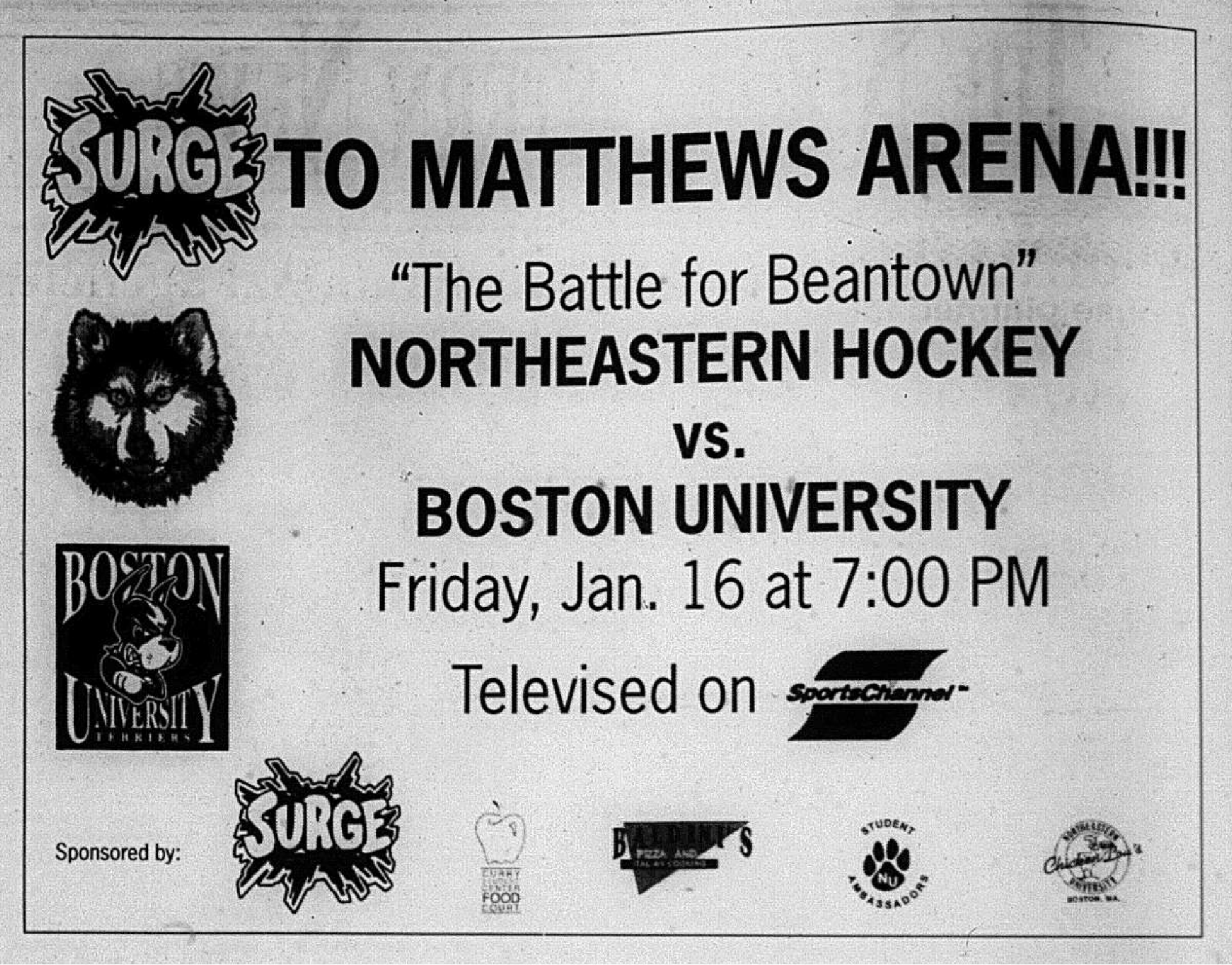
But this night was different, as rivalry games generally are, but especially because of the stretch Northeastern was on and the fact that the game was televised regionally on SportsChannel New England (later known as Fox Sports Net New England, and now NBC Sports Boston).
“We had a different experience with NU hockey than [current students] do,” Straub said. “So individual big nights, I don’t want to say meant more, but they felt more special than I’m guessing they do now because we didn’t have nearly as many of them. So a Friday night, on television, against BU, was a big deal.”
Trocchi was working as a co-op in the sports department of The Boston Globe that semester. He got off his shift that evening and arrived at Matthews just as the game had started.
“So I walk into the lobby of Matthews Arena a little bit into the first period, and I looked at the glass, and I was like, wow,” Trocchi said. “It’s 4,000-plus there for the game.” (4,189, to be exact.) “And I went up to a Northeastern News reporter, a colleague of mine, and I’m like, ‘Wow, what a crowd, huh?’ We hadn’t seen anything like that in a while.”
What also made this game unique was that there was a promotional giveaway for students that night. The Coca-Cola Company had recently introduced a soda brand called Surge into the U.S. market, which aimed to be a competitor to Pepsi’s Mountain Dew, with the same citrus flavor and “extreme”-style marketing. As students had filed into Matthews, they were all given free bottles of Surge at the door.
“I’d never heard of [Surge] before that night,” Straub said. “I don’t know if a lot of people had. Because I remember at least the people around me [being] like, what is this? Why do we have this?”
The game that Friday night followed the script Trocchi mentioned: close, low-scoring, with Robitaille keeping them in it. The Terriers outshot the Huskies 18-6 in the first period, but Northeastern’s goalie stood strong, keeping it scoreless through the first 20 minutes.
The second frame was more of the same, until Albie O’Connell broke ahead and dropped the puck to Nick Gillis, who rifled it past Robitaille to put BU ahead with 4:16 to go in the period. It was the kind of chance they hadn’t been able to finish all night, and it briefly looked like momentum might swing their way.
That lead would last a grand total of 22 seconds. Following the faceoff, Kearns came down the wing, saw he had an opening, and fired the puck. The low shot snuck past Terriers goaltender Tom Noble and brought the Matthews crowd to its feet.
With the game tied for all but those 22 seconds and the large crowd on hand, anticipation began to build. And everyone still had their bottles of Surge.
“I remember I said to my friend, ‘If we win this game, I know exactly what’s going to happen: these things are going to end up on the ice,’” Straub said.
Despite brief 5-on-3 opportunities for both sides late in the third period, regulation ended with the teams deadlocked at one. Then, in overtime, the Huskies broke through.
“I remember I had just got off the bench, someone was changing for me,” Davis said. “The play started in our own zone.”
Davis skated past center ice and passed the puck to Barclay, who was entering the offensive zone on the right side. Barclay handled the puck and then flung a sharp-angle backhand shot at Noble. Somehow, it found its way under his pad and into the net.
“[Barclay] was kind of a player that would just throw the puck on net and it would go in,” Davis said. “I remember thinking he could score from the stands. And I almost remember when he was shooting, going, oh wait, don’t shoot from there.
“I gave it to him, and I was kind of ready for a pass, and I remember thinking in that split second, no, he’s gonna shoot, I’m going for a rebound. And then I saw it go through [Noble’s] legs.”
Weiss, who is now the statistician for Northeastern’s men’s hockey broadcasts on ESPN+ and the radio, had a unique vantage point that night. Normally, in his role as manager, he would be videotaping the game for the coaches to use as film. However, since the game was on SportsChannel and the coaches would just use the TV broadcast, he didn’t have to film that night.
“I wasn’t necessarily on my normal perch that night above the benches where the broadcast team is now, where Rob [Rudnick] and Adam Reid and myself call the games,” Weiss said. “I was spending time both down on the bench a little bit, and then towards the end of that game, I had to be the one to open the locker room. … So I went down to unlock the locker room, and then I went up to the door in the corner there to sort of watch the end of it. And I saw Todd Barclay coming down and he goes and gets by Noble, backhands the goal in, and the place went absolutely nuts.”
The roar of the crowd echoed off of the arena’s vaulted ceiling as Barclay’s teammates jumped onto the ice to mob him, right in front of a stunned Jack Parker and his team standing at the away bench.
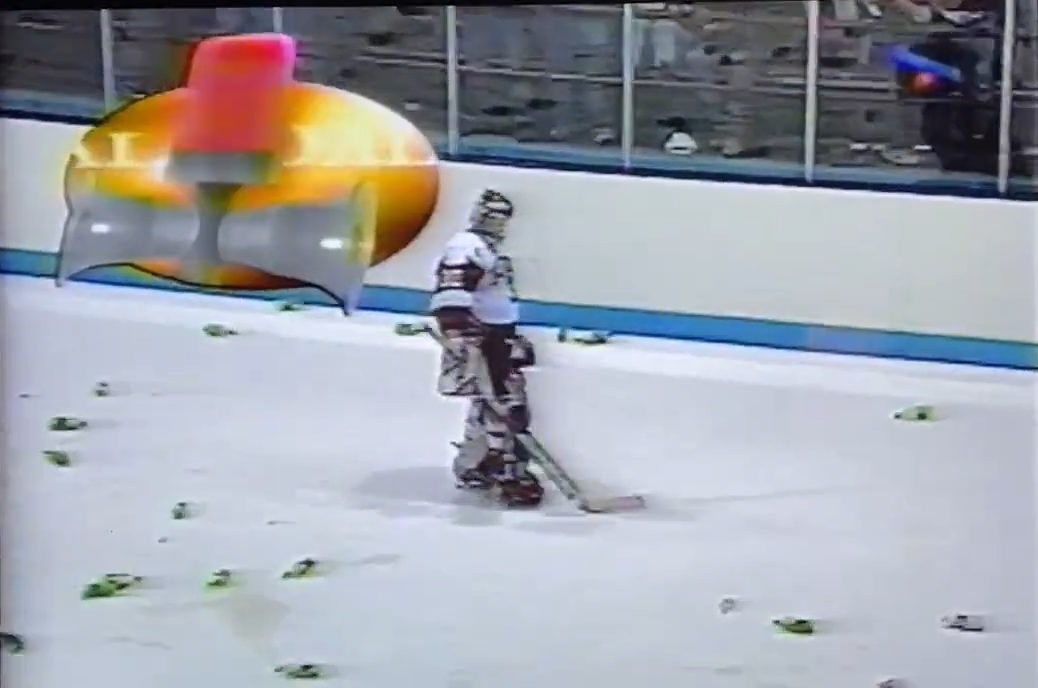
It was during all of that celebration that the skies started to open up. In an instant, plastic soda bottles were being flung onto the ice from every corner of the arena.

“Suddenly, you just see this siege of bottles coming from the stands and things being thrown at once,” Weiss said. “It probably was started by one or two people, but then once a few saw it … you know how sometimes you sort of turn the water on full force and it comes out super fast? It’s like next thing you know, snap a finger, there’s bottles sort of flying over the boards and hitting the ice surface.”
No one on the ice was spared from the onslaught of bottles, no matter if you were a Husky or a Terrier player. Crowder and Parker both nearly got hit as well. And, maybe as an indicator of what people thought of Coca-Cola’s new drink, many of the bottles still had soda left in them.
“I remember getting hit with one of them, and it felt like I got hit with a rock a little bit, because a lot of the bottles weren’t even empty,” Davis said. “[That] probably helped them throw them out on the ice or get them out there. … It seemed like they were showering down forever. I mean, it felt like the bottles never stopped coming down to the point where I was like, when are they gonna run out of these things?”
One of the lasting images of the entire scene for people who were there was Noble trying to take cover from the projectiles in his cage after letting the game-winning goal squeak past him.
“[Noble], and I don’t even mean this negatively toward him, but he’s kind of like in the goalie stance, as low as you can get in the goal, trying not to get hit by the bottles,” Straub said.
Not every fan threw their bottle out on the ice, though.
“I didn’t throw mine, because I am, what can we say in print, a goody two-shoes,” Straub said. “I was afraid my friends were going to get in trouble if we threw it, that kind of guy. … And I actually kept [my bottle] for a while, as like a souvenir, but I don’t have it anymore. I wish I did.”
The headline in The Boston Globe the next day read: “Huskies playing like top dogs”. The headline in the next issue of The Northeastern News kept it simple: “Surge!” (“Where did they come from?” Trocchi’s Northeastern News article began. “You could ask that question about the ’97-’98 Huskies or you could ask that question of the thousands of Surge soft drink bottles that rained down on the ice.”)

With the win, the Huskies were able to take a bit of a victory lap over some of their doubters.
“A lot of people in the press have said, ‘Oh geez, you’re here but you haven’t played Moe, Larry, and Curly yet,’” Crowder was quoted as saying after the game. “Well, we played Moe tonight.”
Unfortunately for the Huskies, there was no storybook finish to this season. Going for the weekend sweep at Walter Brown Arena the next night, Northeastern fell, 3-2. (The Huskies would not earn consecutive wins against BU, in fact, until March 2011.) The Terriers also claimed the other two meetings that season, including a 4-1 win in the Beanpot semifinal game. The Huskies were eliminated by Crowder’s former squad, the River Hawks, in the Hockey East quarterfinals.
Still, “Surge Night,” as it has come to be known, has been viewed as a turning point in terms of fan interest in hockey at Northeastern. It also helps that the game took place around a time when the Boston campus and student population was expanding.
“Northeastern was just becoming more of a residential campus when I was there,” Trocchi said. “A lot of new dorms were going up, a lot more out-of-state kids, the academic profile was starting to improve. People were looking at Northeastern as, it’s similar to BU, except, wow, this campus is pretty nice, because the area near Centennial Common had just been built, and there was more of you were in the city, but you had more of a campus instead of just being on the street like BU was. So it was a period in time when everything, inch by inch, was starting to improve.
“Like I said, there were 1,500 a game. … But this game was a harbinger. The crowds started coming after that. Northeastern … was turning from a commuter school into a real campus, and spurred by this game, attendance in the next few years averaged 3,000-plus for a team that was slowly improving, but kind of one step forward, two steps back. But from this game forward, hockey became more popular as a sport for fans to watch. It kind of became the thing to do on campus. So if it was Friday or Saturday night, you were going to Matthews Arena for hockey, where, when I first arrived, it was just in the pits.”
The origins of the DogHouse, Northeastern’s boisterous student section, can be traced back to this season as well.
“One of the bigger things that Coach Crowder did that really goes a bit unnoticed was the investment he put in to help the DogHouse develop really to what it is today,” Weiss said. “There were many days where he’d have [the DogHouse leaders] down to the locker room for pizza, just talking about, what do you guys need to help create the atmosphere you want to be in the arena here?”
Unlike it did for the Northeastern hockey program, the game didn’t give the soda brand the jump-start Coca-Cola was seeking. Surge failed to gain the market share the company had hoped, and it ceased production in 2003. The brand has been occasionally brought back for a limited time in various forms, including in Coca-Cola Freestyle machines at certain Burger King locations up until a few years ago, but it is not currently available in any mainstream form of purchase.
However, it delivers a piece of nostalgia for the players, coaches, and fans at Matthews Arena that night.
“I remember going into a grocery store [in 2017], and there was a Surge,” Davis said. “And I took a picture of the Surge can and sent it to Matt Keating, who was on the team at the time. I mean, this is 20 years later … just reminiscing about how crazy this game was.”
Davis didn’t buy the can, though. He’s actually never tasted Surge. Neither have Straub or Weiss.
“To me, it tasted awful, it was just a terrible knockoff of Mountain Dew,” Trocchi said. “And of course, after the game, it was kind of everyone’s favorite. Everyone drank it around campus for a little while. But it didn’t last long.”
A Northeastern News column, in its irreverent style, perhaps summed it up best following the game.
“Surge’s use found,” the headline read. “Despite the taste of the new soft drink, it has a use — after the enormous victory over BU, the ice was littered with the soda bottles.
“Although it would have been much better if more BU players were hit.”
Be sure to tune into WRBB’s coverage Saturday night as Northeastern hosts BU in the final event in the 115-year history of Matthews Arena. Luke Graham, Zeno Minotti, Armaan Vij will have the call at 7 p.m. on 104.9 FM and wrbbsports.com/listen-live.
Jordan Walsh is a fifth-year student at Northeastern who has been with WRBB Sports since 2021, primarily covering men’s and women’s basketball. You can read all of his articles for WRBB here and find him on Twitter here.